
General Information
Organ Printing is the name given to organs that have been created using 3D printing technology. It is a health issue and it is being researched and created to address the lack of available organs for people who need them. The idea is that if, for example, a person’s heart valve or liver were to fail then a new one can be created and put in place of the old one instead of having to wait on the organ transplant list to maybe never receive one.
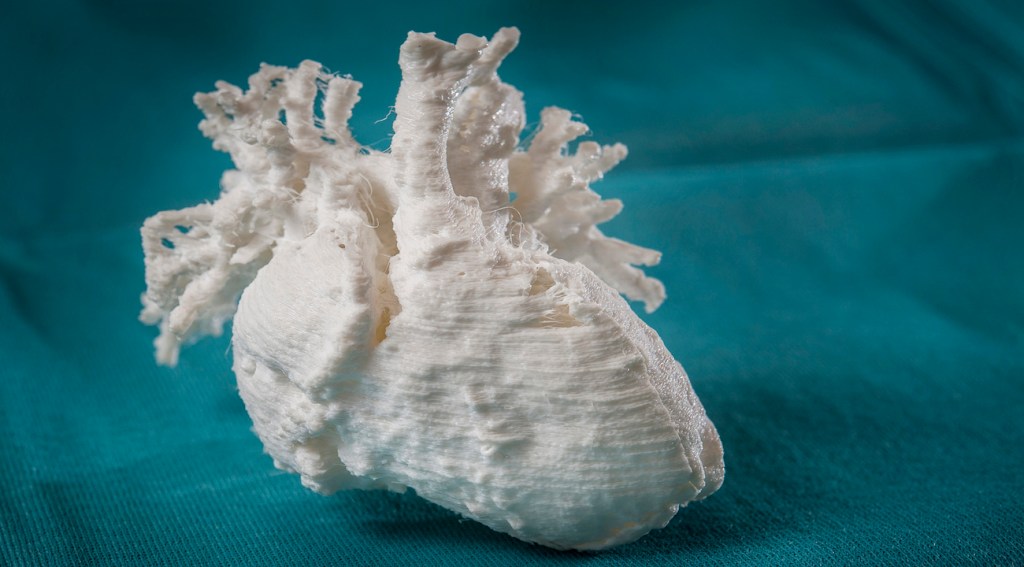
3d geprint kinderhart
Technical and Historical Information
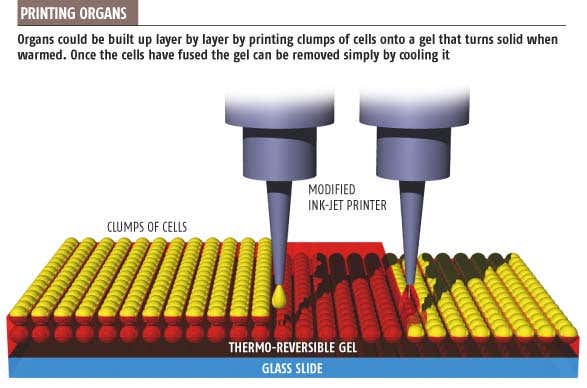
The first device capable of 3D printing a group of cell structures was patented by Thomas Boland in 2003. He was able to repurpose an inkjet printer to hold and distribute a bio-degradable gel that is in a liquid state when below 20⁰C and a solid state when above 32⁰C. This creation sparked an advancement in the field of bioprinting which has been advanced to include the idea of printing whole organs.
The organs that are currently able to be made, e.g. blood vessels, are being created using Thomas Boland’s creation, the modified inkjet printer method. This method creates the organs by using many droplets of the cellular material stuck together. Each drop sticks together until it forms a cohesive structure that can then be used in place of the patient’s original blood vessel. This method is relatively fast.
Impact of Technology
This is an emerging technology due to the slow speed in which it is being advanced. It has been 16 years since the Thomas Boland patented the first a device capable of 3D printing cell structures and 3D printed organs are still not close to being widely available for areas outside of lab-use. More complex organs such as the pancreas and heart also have yet to be successfully reproduced using the technology in its current state. It should also be classified as emerging due to the fact that it has not replaced the current method of organ replacements which is through the use of organ donations by deceased bodies.
References
Bajaj, P., Schweller, R., Khademhosseini, A., West, J. and Bashir, R. (2014). 3D Biofabrication Strategies for Tissue Engineering and Regenerative Medicine. Annual Review of Biomedical Engineering, [online] 16(1), pp.247-276. Available at: https://www.ncbi.nlm.nih.gov/pmc/articles/PMC4131759/ [Accessed 28 Aug. 2019].
Cooper-White, M. (2019). How 3D Printing Could End The Deadly Shortage Of Donor Organs. [online] Huffingtonpost.com.au. Available at: https://www.huffingtonpost.com.au/2015/03/01/3d-printed-organs-regenerative-medicine_n_6698606.html [Accessed 28 Aug. 2019].
Daniel, D. (2018). 3D printing implants and organs is the new reality. [online] Healthcare IT Australia. Available at: https://www.healthcareit.com.au/article/3d-printing-implants-and-organs-new-reality [Accessed 28 Aug. 2019].
Choi, C. (2003). Ink-jet printing creates tubes of living tissue. [online] New Scientist. Available at: https://www.newscientist.com/article/dn3292-ink-jet-printing-creates-tubes-of-living-tissue/ [Accessed 28 Aug. 2019].
DonateLife. (2019). Facts and statistics. [online] Available at: https://donatelife.gov.au/about-donation/get-facts/facts-and-statistics [Accessed 28 Aug. 2019].




 MathewTech